Recently, the market looks decent; overall, it seems to be moving in a positive direction. Based on past experience, the first ten days of each month tend to see lows, while the last ten days are likely to see highs; currently, this pattern seems to hold true.

Currently, the biggest uncertainty in the market is still at the macro level, such as whether the U.S. will cut interest rates and the tariff issues between the East and West.
Although the possibility of a rate cut in June is still relatively high, as long as these two matters are not settled, the market is easily swayed by some minor news.
Currently, the White House says that Trump is willing to reach an agreement with China, and the tone has softened a bit, which is a small positive. But we shouldn’t be too optimistic, as nothing has really materialized yet.
If the market can continue to rebound in the coming days, late April may see a surge upwards, and the peak is likely to appear during this period.
Then, adjustments may start at the end of the month, pulling back to early May, but by mid to late May, the market may begin to speculate on 'interest rate cut expectations,' which could create trading opportunities.
BTC trend
Back to the BTC trend, it actually looks more stable than U.S. stocks now, with less volatility, and due to the long trading hours, it often shows a pattern of dropping a bit during the day and pulling back at night.
Like this morning, BTC only spiked to 84,300, and it is still being held down at the 85,000 level. If it can’t break through, it will continue to oscillate.
Even if it breaks through 85,000, there’s still the hurdle of 87,700 waiting ahead. So, it will be quite difficult to rise higher.
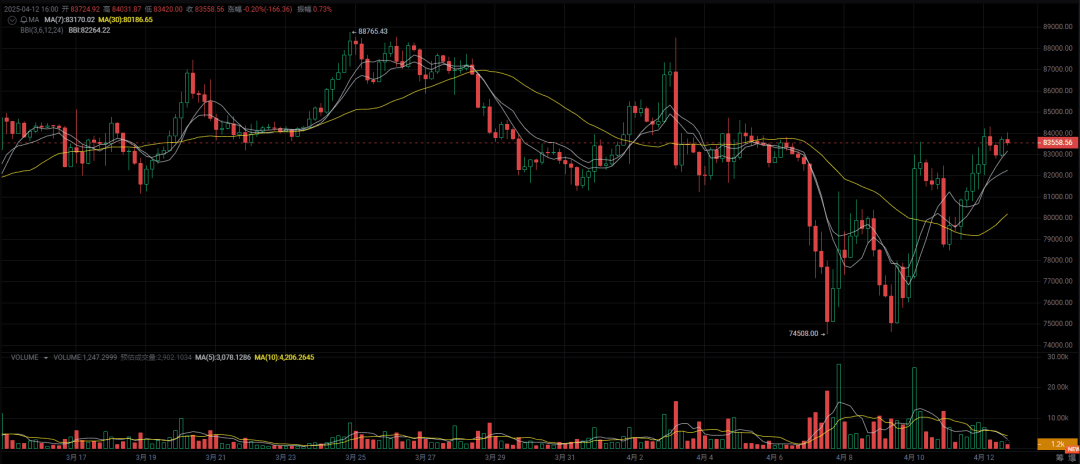
Although it is said that there shouldn't be any particularly negative news recently, that doesn’t mean we can just charge ahead.
The reason is simple; many people previously bottomed out around 75,000, and now that the price has risen, they will certainly consider cashing out, and these selling pressures will also affect price trends.
At the end of the month, there are also U.S. GDP and PCE data; if the data falls short of expectations, it could trigger 'risk-averse sentiment' in the market.
Next, we will have to look at the inflation and employment data for April to be released in May, as these will significantly influence market direction.
Especially since the inflation data includes tariff impacts. If the economy slows down and inflation remains high, and if the U.S. really cuts interest rates, people may interpret it as 'cutting rates out of fear of recession,' which could make the market more worried.
Unlike last September's 'following the trend' interest rate cuts, this 'market-saving interest rate cut' may not necessarily be good news for U.S. stocks and BTC.
As for Ethereum, its performance has indeed been quite poor, and it has not been able to keep up with the pace of Bitcoin. Many people are even starting to wonder if it will drop to three figures.
I don’t think it will be so pessimistic; the market is like this, rising is feared, but falling is even more feared. Panic just amplifies everyone’s expectations.
Don’t forget that on April 21, there will be the Ethereum upgrade, which is the biggest positive news besides the staking ETF.
If the market can stabilize, this upgrade may bring about a decent market trend.
Recently, Coinbase has been frequently holding voting for listings; it is recommended to view this situation with caution.
Large/medium market cap old projects: Basically have been fully unlocked, the project party may take the opportunity to dump and sell, which carries a higher risk.
Medium market cap new projects: Usually not unlocked yet, strong control over the market, and it's easy to create hype, leaving room for operation.
Small market cap projects: Once they are listed, it’s basically an unexpected event; it’s not too late to rush in once the results are out.
Projects with a history of malicious manipulation: don’t touch them; it’s better to miss out than to fall into a pit.
Overall, the news of listing a coin does not necessarily mean it will rise or fall; the key is whether the project party has a large amount of chips. Once they want to dump, it doesn’t matter what gets listed.
Post a Comment